
Scorch:
Scorch is caused by an infection by phytoplasm, a type of bacteria without an outer shin. It can only live inside vessels inside plant and in saliva gland of sucking insects. The insects are the transmitting vector.
A recent suggestion for cure of scorch involves heating the plant to 104 degrees F. for a few days. This seems to kill the scorch, leaving the plant unharmed. This can be done with a covering over the plant, but care must be taken that the temperature doesn't get too hot and cook the plant.
Borer:
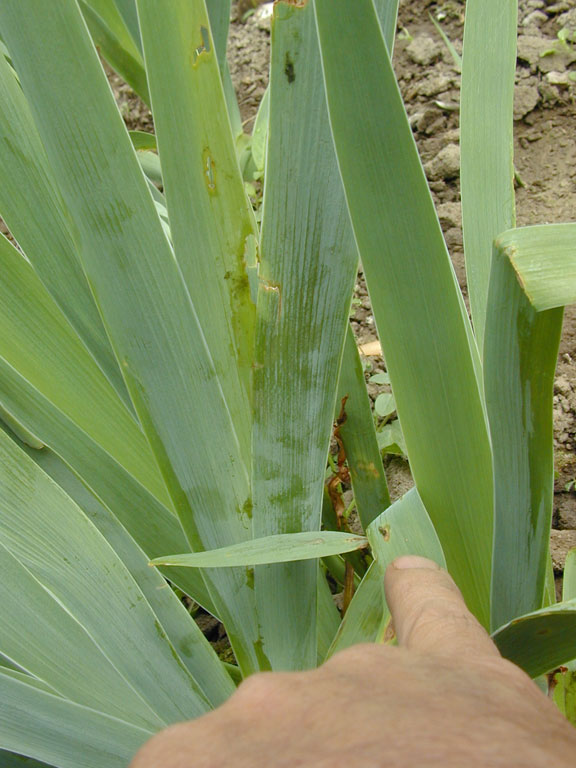
This what borer looks like early in season
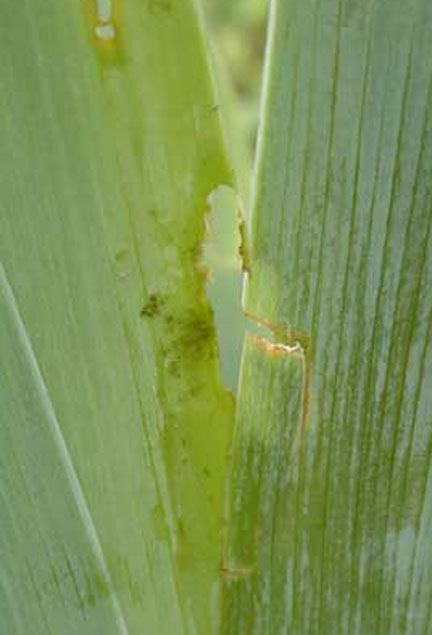 A closer look
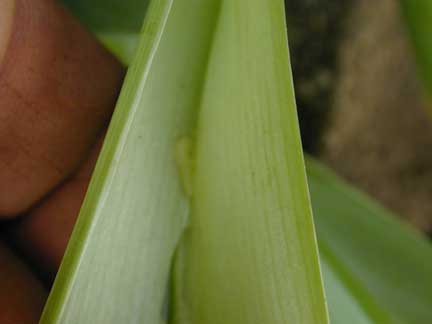 At this time (during blooming season) the borer is very small
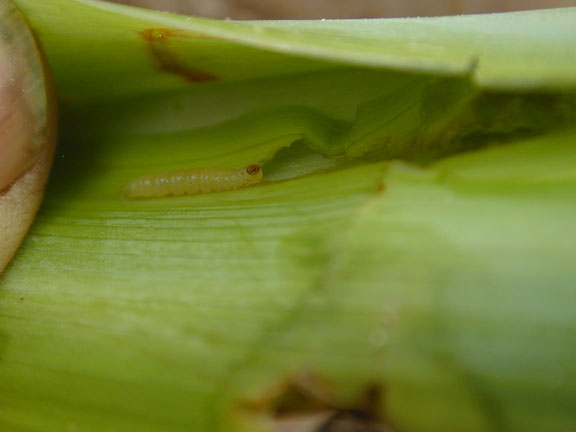 And even closer
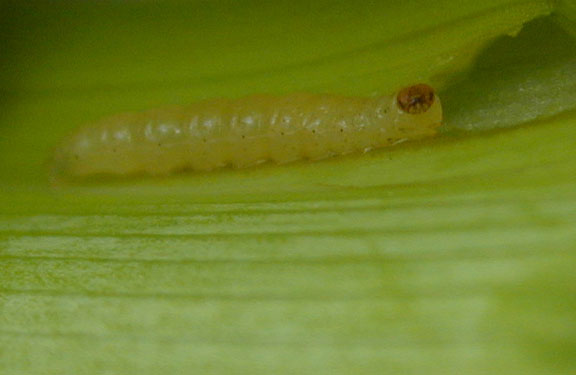
Only about 1/16". They gradually eat their way down stem and enter rhizome where they continue to grow. Reaching about 1.5" in length. Matur borer is pinkish. They then go into pupa stage, about mid to end of August in my ag zone 4 garden. The warmer the climate, the earlier they reach maturity. .
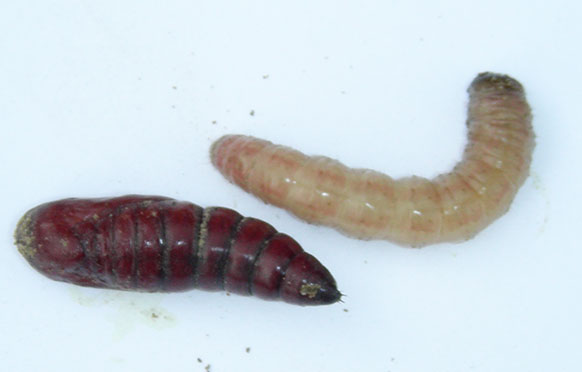
As moth, hatch in early Sept-October to lay eggs for next season in my ag zone 4. The warmer the climate, the earlier this happens.
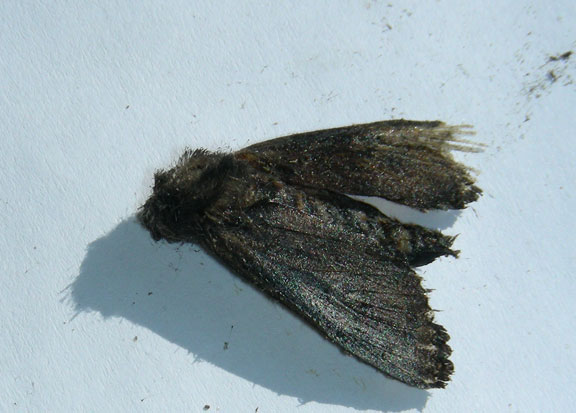
Once you know what to look for , hand removal is not that hard , or theat time consuming. But early in season, before they rech rhizome and do major damage.
This is an annoying and unsightly condition involving small brown spots on the leaves. This is a fungus that, though unsightly, does little damage to the plant. A spray of Benelate (or other fungiside) early in the season can help with this, although it is often necessary to repeat several times in the season. Often the easiest way to deal with it is to just remove the unsightly leaves and dispose of them (but not by putting them in the compost). An increase of nitrogen in the fertilizer can often be helpful, but too much nitrogen can make the plant more susceptible to soft rot.
This is seen more often in older clump where there are a number of factors at work. With the crowding, there is less air circulation between leaves. There is less nutrients available to each fan. Heavy rains can wash out nitrogen. With the plant being less healthy, the plant is more susceptable to diseases.
The fungus spores are in the soil. They are more prevelant if infected leaves are left over winter. So a clean up of infected leaves in fall can help reduce amount of fungus spores present.If there are major problems, a mulch around base of plant can help. DON'T place mulch at base of plant , leave it at least 3" awaw from rhizome.
In following pictures, various pictures of infected plants. This includes a badly infected plant, a dead leaf, and close up of an infected spot.
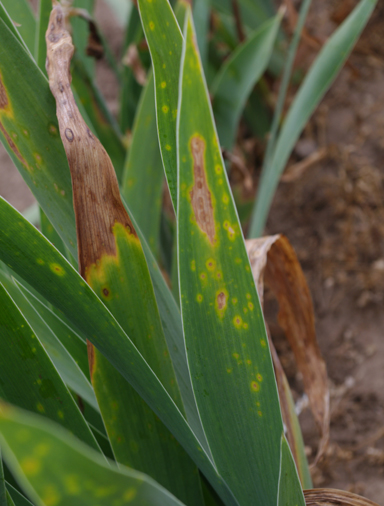 I
I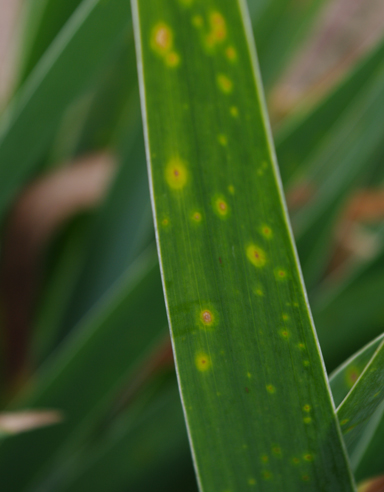
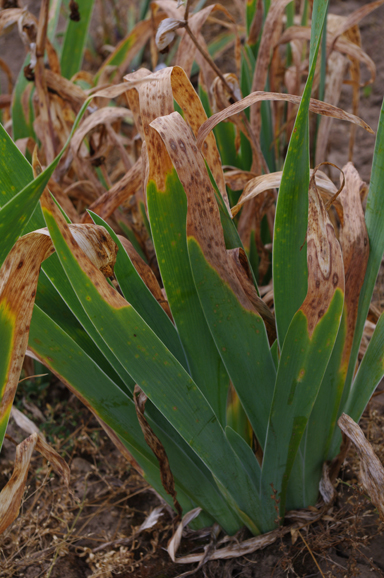
This fungus has been called by several names. "Mycosphaerella macrospora" seems to be current name, but it has also been called "Didymellina macrospora", "Cladosporium iridis", " Heterosporium gracile", and "Heterosporium iridis"
This fungus, by whatever name you use, can also be hosted on Hemerocallis (daylies). This year (2012) there has been reported a problem with dayliles reffered to as "Midwest Malaise". it very well could be same fungus, burt shows slightly differernt as it is on a diferernt species. I suspect that it is worse this year because of weather conditions. A wet sprin with lots of rain can leach out nitrogen in soil, placing plant under stress. Then infection takes advantage of the weakened plant. The fungus doesn't need to transfer directly from iris. It can have been present on the daylilies for a number of years, but only causing mnor problems, that have not been paticularly noticed. So fungus is present, waiting to take advantage of conditions, such as wet spring, followed by hot weather.
. Have mulch around base of plant to prevent splashing of fungus spores onto leaves. Giving plant some nitrogen will help streanth plant. You could try a foliage fertilizer. Avoid overhead watering if you can.
This is most often seen in mid summer . Frequent inspections at that time would be advisable. The sooner it is caught, the better. Any rot should be removed. I use an old tablespoon that has its edge sharpened. Then I spray the cleaned part with a mix of half bleach and water. Other possible sterilizer/cauteriser are Lysol, powdered sulphur, comet cleanser, or disinfectant liquid soap. Exposure to sunlight also works. I do not remove rhizome from soil, I just scrape at top where rot is. If you catch it late in a clump, that lifting clump may be best approach, ansd you can then clean it up and canbetter see where infections are.
Soft rot is caused by the bacteria Pectobacterium carotovorum, previously called Erwinia carotovora. This bacteria varies widely and there are many known subspecies, some are specific to certain species of plants.
Planting depth does not seem to have any , affect on development of rot. The rot infection starts on the soft tissue, that is leaves at the interface of soil and air. Regardless of planting depth, there is always an interface. I have seen any evidence that planting depth has an effect of frequency of soft rot. I did a three year study of five different planting depths. Each planting depth had some soft rot, which was untreated. At the end of the experiment, the iris that fared best was the ½" deep group. All of the iris were the same cultivar and each group was carefully matched to be equal before planting.
On internet groups people in warmer climates, such as Tennessee and Texas where and when there is lots of summer rain, get a lot of soft rot. Some photos show plants planted covered , and some with large amount of infection, with rhizomes are planted half exposed. As rot does not start in rhizome, being covered or not covered does not seem relevant. Often rot is not discovered until it has progressed, and rhizome is mostly destroyed. So it seems as if it starts with rhizome. Careful observation, and catching it early shows it starting on leaves.
Most ‘google’ and many internet sources state that soft rot stinks. Fact is that soft does not stink. There often is a stink, but this is from decaying plant tissue and colonization by secondary micro-organisms. The smell is not there very early in infections, only later. IT IS NOT A DIAGNOSTIC CRITERIUM. I usually catch it early, and it does not smell at that time.
Soft rot bacteria works best in temperature range 22-35C (73-95F) and at high humidity. Any thing that encourages air flow will reduce humidity at ground level. This includes frequent dividing and proper spacing. Older clumps are particularly vulnerable. Weeds will also hold moisture and provide a great environment. Planting next to anything that decreases air flow will also increase ground level humidity. Mulching will also increase ground level humidity.
A healthy plant fights off infections, including soft rot. Getting new plants growing quickly also helps. New roots get a better start in a moist environment. Planting partially or half exposed, leads to drying out at root zone and can inhibit growth of new roots. Crowded clumps leads to weaker individual fans.
Not as much of a concern in most Canadian climates, but a big concern in warm and humid climates. Most years I have a dry summer and little soft rot. There have been a few wet summers and a lot of soft rot. It does vary greatly from year to year.
There is no preventative treatment. Fungicides are useless as it is a bacteria infection. Removal of soil or serialization of soil is not effective. Studies show that alls soils around the world have the bacteria present. Doing it’s regular job of eating dead organic material. It is called an opportunistic organism. That is it will take advantage of a situation to go from eating dead organic matierial to attacking a living plant. Soft rot cause s tremendous losses in agriculture. Millions have been spent looking for a preventative, without any success. Best success in agriculture has been to breed for resistant cultivars. Some iris are just ‘rotters’ and will be prone to rot . In my own breeding program, I do not treat any seedling that rots. Just let mother nature take care of it, or discard it.
In process of enriching soil, adding organic matter is a common and a good practice. But use well composted material, and in moderation. Excessive compost can lead to more soft rot bacteria in soil.
For information purposes. I grow several acres of iris and have been growing iris for 40 years. I have taken several advanced micro-biology courses and several advanced plant pathology course recently at University of Guelph. I have looked intensively into the Scientific literature, the original published papers, not blogs or U-tube videos . I look at things objectively to find out what is going on. Feel free to send me any information that may show things different then what I have posted. Remember, each year is different from every other years. Some iris are more prone to rot then others.
Science stuff
The soft rot bacteria requires high humidity and air to start its infection. It is basically an opportunistic pathogen. It is always present in the soil, where it’s normal function is to digest dead plant material. Given an opportunity it can switch from being a saprotroph (feeding on dead plants ) to being a necrotroph (feeding on living plants). For this to happen it needs air, moisture and warmth. Crowded clumps with poor air circulation provides a prime opportunity for it to grow, as moisture is retained. To switch from eating dead plants to feeding on live material requires a change in it epigentic programing. This happens through a process called quorm sensing . This happens through a build up of a large number of bacteria, and when it reaches a certain density, signal is given, and all the bacteria at same time switch to Digesting the cell wall material called pectin (hence it’s name Pectorum) . Plants have a defence against this bacteria, but this defence is overwhelmed by a mass attack. So it is a strategy by the bacteria to over come normal plant defences.

 2021
2021